Note
Context
The EU MFA module of the MIC3 model framework (Model for European Industry Circularity and Climate Change Mitigation) is a multi-regional dynamic Material Flow Analysis (MFA) of the basic materials steel, plastics and cements. In the baseline workflow of MIC3 shown in Figure 1, it receives inputs from the Computable General Equilibrium (CGE) module, the energy system module, and the global MFA module. The EU MFA provides output for the industry modules. Within the MIC3 framework, the EU MFA plays a key role for assessing circular economy measures. These relationships are described in detail in other documents. [1] The present documentation focuses on the design of the EU MFA module.
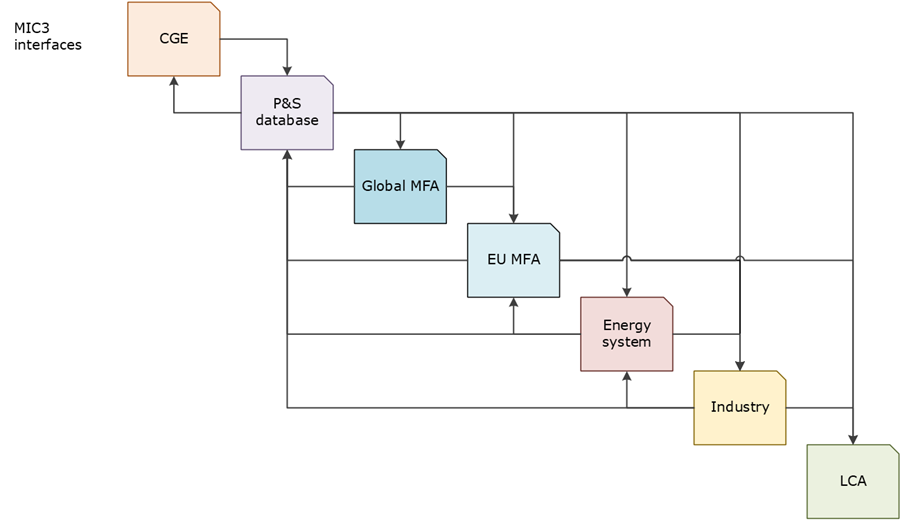
Figure 1: Interfaces among the MIC3 modules
The module is built as a succession of processes connected by flows of the basic materials. What happens in each process to each flow is driven by exogenous parameters such as consumption levels, product lifetimes, trade and waste collection rates, which are set inline with the respective MIC3 scenario definition. Figure 2 presents a simplified view of this model design.
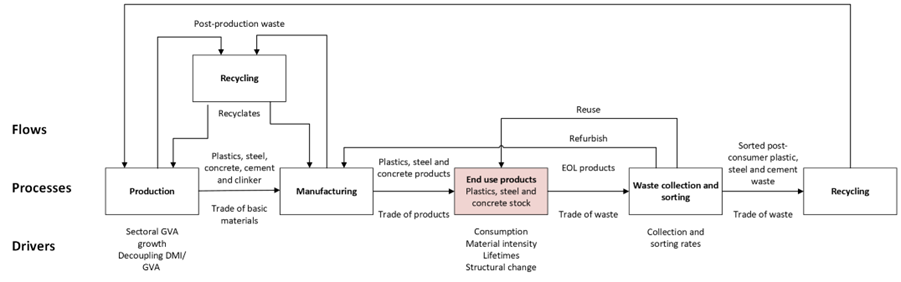
Figure 2: Simplified model diagram for the EU MFA
The module is programmed in python, built on an adapted version of the ODYM framework, namely flodym. The main difference to the ODYM framework is a simplified coding of array operations using the einsum function. Data inputs occur through pre-formatted csv files and results are saved to csv. It can be run locally on a laptop after installing minor requirements.
Module design
The EU MFA module is a dynamic MFA, which is represented in a process material flow diagram in Figure 3. With the objective of analysing the impact of a circular economy in context of industry decarbonisation, the MFA module assesses the three emission-intensive basic materials steel, plastics and cement as well as their end use sectors. In general, the future development of material production volumes and secondary material availability are driven by the use phase and trade.
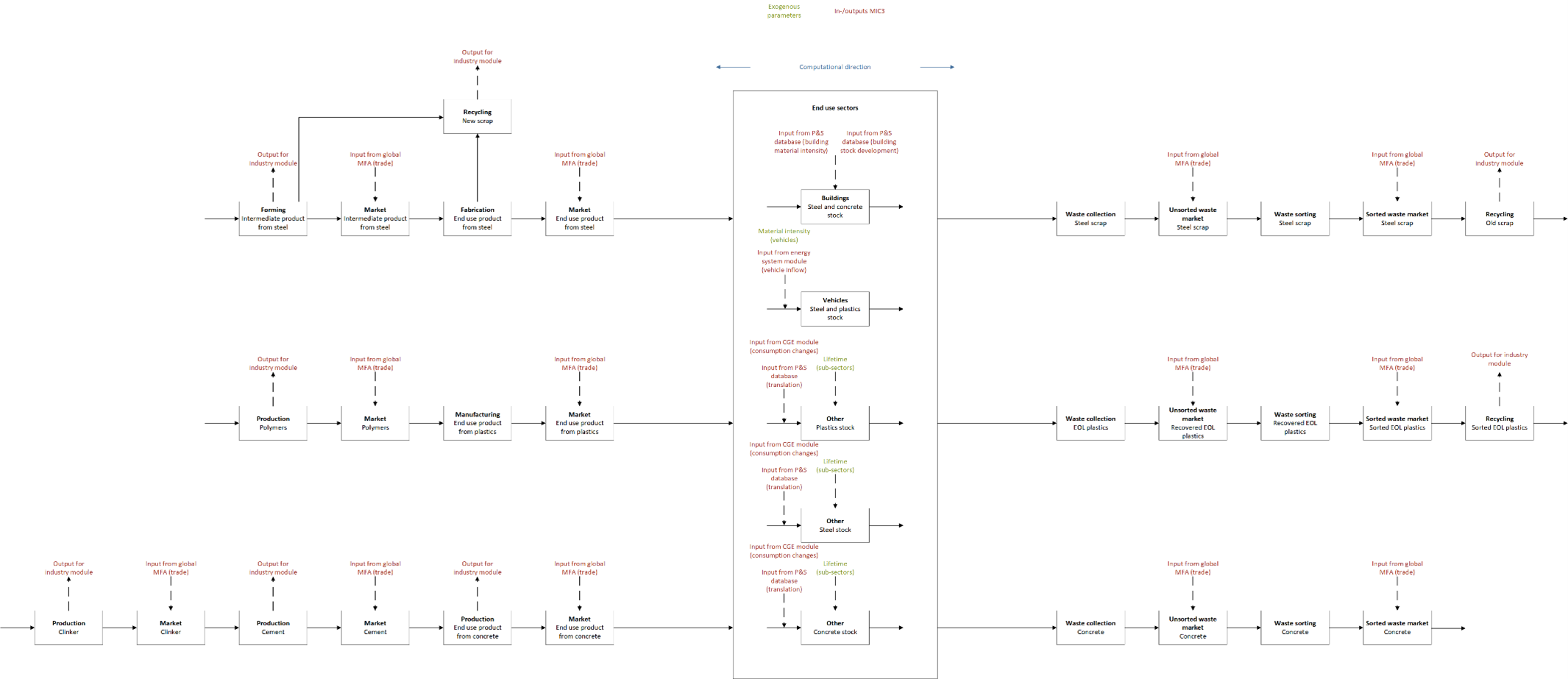
Figure 3: Diagram for the EU MFA module
The EU MFA module incorporates a diverse range of product types across the end use sectors, spanning from composite products (e.g., vehicles), to mono-material components that form part of composite products (e.g., moulded polyurethane seats in vehicles or PVC profiles in buildings), and mono-material stand-alone products (e.g., plastic packaging). For this purpose, the MFA module can combine five sub-modules to ensure coverage of all end-use sectors and detailed analysis of particularly relevant sub-sectors. In detail, this means a bottom-up stock-driven approach for buildings driven by the stock development, a bottom-up inflow-driven approach for vehicles driven by new passenger car registrations as well as three top-down inflow-driven approaches for steel, plastics and cement in all end use sectors driven by consumption changes. In this context, a particular challenge arises from the differentiation between broad application sectors (e.g. Automotive, Buildings & construction, Packaging, Electrical & electronics equipment, Agriculture etc.) and detailed application sectors that are parts of the broad ones (e.g., “vehicles” as part of “Automotive”, “Residential buildings” as part of “Buildings & construction”), see also Figure 4.
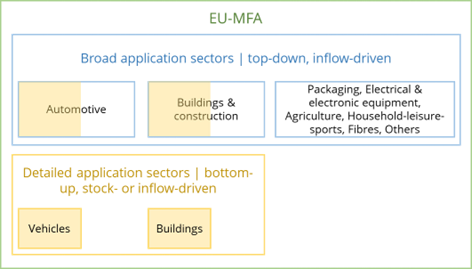
Figure 4: Product and sectoral resolution of the EU MFA module
To ensure consistency between the sub-modules and account for the varying differentiation between broad and detailed application sectors, the EU MFA relies on statistical data for a base year. In detail, we use a somewhat different inflow-driven approach than for modelling scenarios. The reason is data availability for basic material demand: it is readily available for the “Production” process in the module’s material flow diagram. Adding net trade to the “Production” yields final demand, which in turn is the driver-variable that is modified in scenario building. In general, the bottom-up material flows for the detailed application sectors are subtracted from top-down flows for the respective broad application sector. The residual (“Other”) is then extrapolated. Rates of change in consumption delivered from the CGE module as well as translation factors from the P&S database will provide the basis for these modifications. Therefore, in scenarios, the “Production” is an output of the model, while final demand is an input parameter. This approach necessitates a reference development when circular economy measures are considered. The circular economy measures affect the top-down and bottom-up inflows independently of each other.
Code structure
The EU MFA module consists of sub-modules for the three basic materials steel, plastics and cement, as well as for the application sectors buildings and vehicles. The data and source code for each sub-module in their own sub-folders follow the same structure:
data: contains the input and output data for the sub-modulesscenario_material``or ``scenario_application: sub-folder for a sub-module’s scenarioinput: contains the input data for the sub-moduledatasets: contains the input data for the exogenous parametersdimensions: contains the input data for the dimensions indexing the parameters and variables
output: contains the output data from the sub-module
src: contains the source code for the sub-modulescommon: contains the common functions for the sub-modulesmaterialorapplication: contains the source code for the sub-modules*_definition.py: contains flodym objects defining the sub-module’s dimensions, parameters and variables*_mfa_system.py: contains the computation of the sub-module’s material flows and stock dynamics*_export.py: contains the export functions for the sub-module’s results*_model.py: contains the sub-module’s class wrapping the other files
The documentation of the sub-modules in the following chapters focuses on the MFA models implemented mainly
in the *_definition.py and *_mfa_system.py files. Each chapter contains the following sections:
Indices: in flodym all parameters and variables of the model are indexed. Those indices define the system boundaries, e.g. temporal and geographical resolution, considered materials, products, sectors. Even though the sub-modules of the EU MFA can work independently from each other, we defined consistent indices across the sub-modules to ensure their consistency and to enable their combination.
Parameters: the exogenous drivers of the models (e.g. consumption levels, product lifetimes, trade and waste collection rates) expected for the dimension defined as indices.
Variables: the variables (e.g. stocks, flows) are endogenously calculated by the model.
Processes: the transformation steps between flows are described in plain English and with an algebraic formulation of the equations that govern these processes.
Footnotes