Note
Steel
Design
The steel sub-module is a dynamic Material Flow Analysis (MFA) of steel products. It is built as a succession of processes connected by flows of steel, either as semi-finished products, embedded in goods, or in scrap. It accounts for the contamination of steel scrap with copper. What happens in each process to each flow is driven by exogenous parameters such as product lifetimes and scrap collection rates set by the user to construct a scenario. The figure below presents a simplified view of this model design.
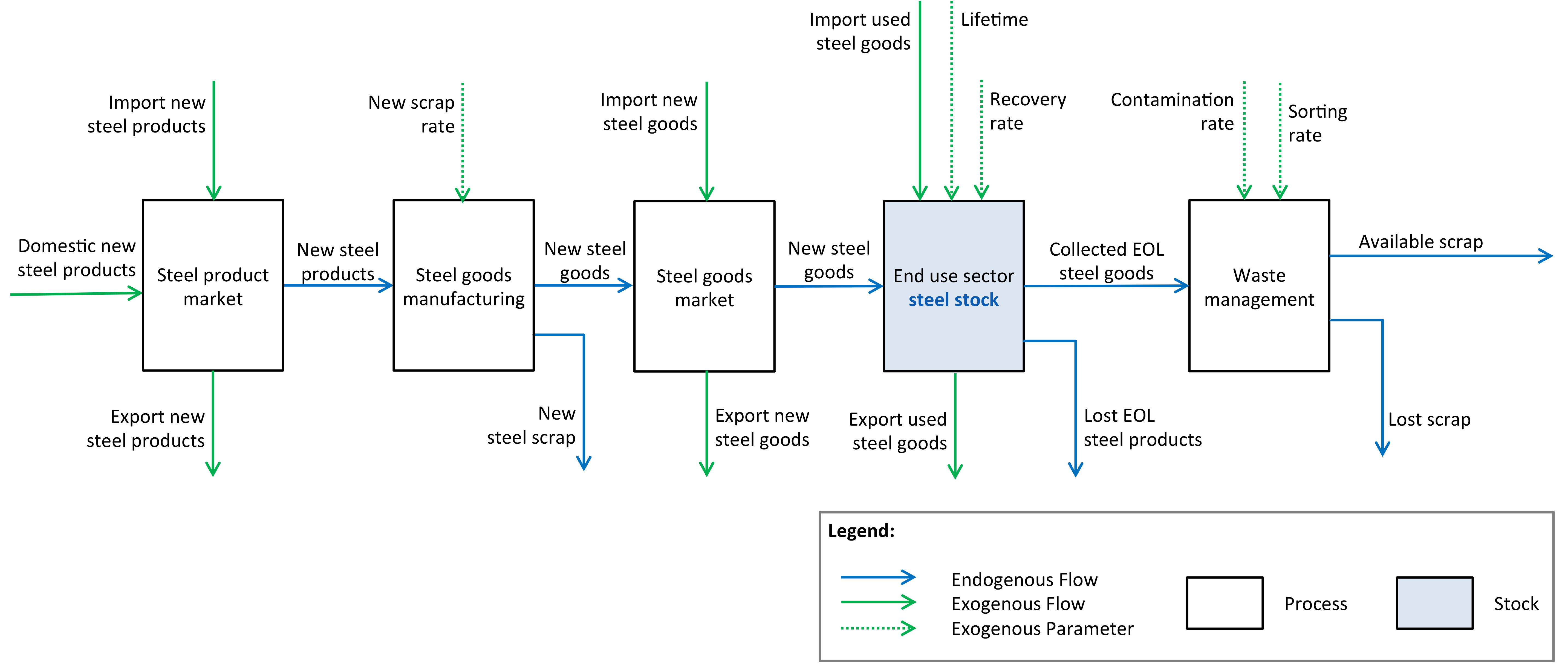
Simplified diagram for the steel sub-module
The following flow diagram (see Figure below) shows details about parameters and varibales. The code implements this design using flodym, an adaptation of the ODYM framework. Some general-level explanation are in order:
If a flow or parameter is indexed with e.g. (r,t,c,s,p,e) it means that the model expects values for this flow or parameter for each combination of regions (r), years (t), age cohorts (c), use sectors (s), products (p), and elements (e). Index combinations for which input data is not provided receive zero as default value or in some cases may be filled out through interpolation.
The term "products" in the diagram refers to semi-finished products. The term "goods" refers to finished products (packaging, cars etc.) manufactured with semi-finished steel products and possibly other materials. The model does not quantify, for example, how many cars are produced, but how many tonnes of steel, differentiated by type of semi-finished products, are contained in the cars produced.
The index (e) allows us to track individual elements in the steel product and scrap flows. In addition to the total mass of steel flows (e = All), the copper contamination (e = Cu) is also tracked. Note that further contaminants could be considered but is not currently implemented in our datasets.
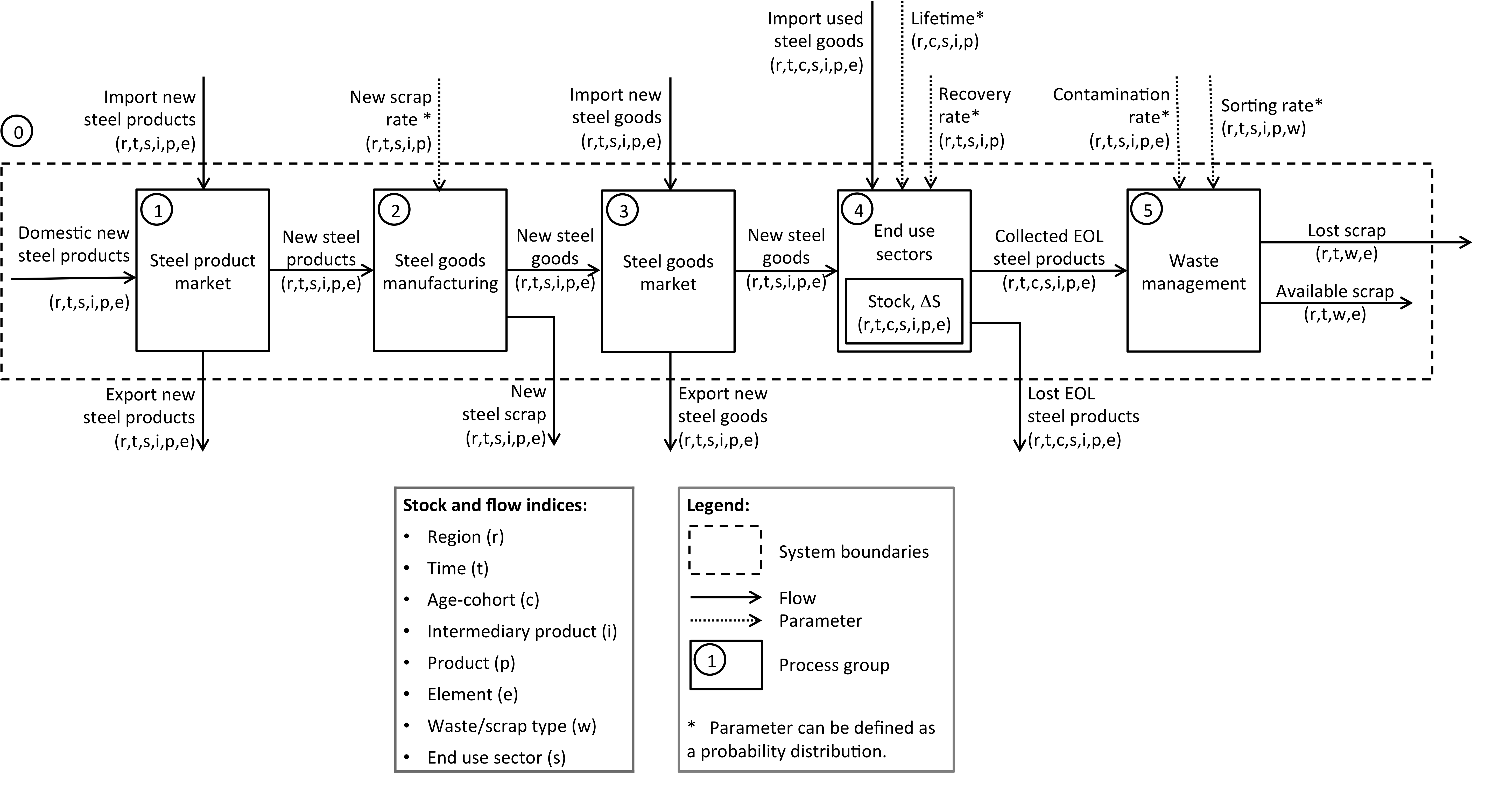
Full diagram for the steel sub-module
Indices
The following table presents the dimensions indexing the parameters and variables (stock and flows) of the MFA model for steel.
Dimension |
Index |
Description |
|---|---|---|
time |
t |
Temporal resolution, e.g. yearly values from 1950 to 2050 |
element |
e |
‘All’ covers the mass of the steel products incl. contamination, further individual elements can be defined, e.g. for contaminants such as Cu |
region |
r |
Geographical resolution, e.g. EU member states |
age cohort |
c |
Age cohort of application sectors |
use sector |
s |
Broad application sectors |
product |
p |
Considered steel products (e.g. Rebar, Wire Rod, Plate, Hot Rolled Coil etc.) |
waste categories |
w |
Categories depending on the use sector the steel scrap originates from |
Note: the meaning of the index “element” (All or Cu) can be misleading. The All index actually refers to the entire steel product while the Cu index refers to the copper contamination contained in that product. For example a scrap flow of 100 kg with known 3% copper contamination would look like in the table below.
region |
time |
sector |
waste_category |
element |
value |
unit |
|---|---|---|---|---|---|---|
Germany |
2010 |
Vehicles |
Industrial Electrical Waste |
All |
100 |
kg |
Germany |
2010 |
Vehicles |
Industrial Electrical Waste |
Cu |
3 |
kg |
Parameters
The following table presents the data structure and signification of all input parameters expected by the MFA model for steel.
parameter |
index |
description |
|---|---|---|
Lifetime |
rsip |
Steel product lifetimes |
EoLRecoveryRate |
rtsip |
Recovery rate of end-of-life (EoL) steel products |
ScrapSortingRate |
rtsipw |
Sorting rate of scrap steel |
Contamination |
rtsipe |
Contamination of steel from scrap management |
DomesticProduction |
rtsipe |
Domestic production of steel products |
ImportNewProducts |
rtsipe |
Import of new steel products |
ImportNewGoods |
rtsipe |
Import of new steel goods |
ExportNewProducts |
rtsipe |
Export of new steel products |
ExportNewGoods |
rtsipe |
Export of new steel goods |
InitialStock |
rtcisipe |
Stock of steel products, initial modelling year |
NewScrapRate |
rtsip |
Rate of generation of new scrap in steel goods production |
Variables
variable |
index |
description |
|---|---|---|
… |
… |
… |
Processes
The following presents the equations governing each of the processes in the Full diagram for the steel sub-module. For each process we provide a short description in plain English, an explanation of the exogenous parameters and model variables, and an algebraic formulation of the equations governing the process. For the parameters and variables we can use both common names as in the diagram and code names as in the algebraic formulation.
Note
Process (1) “Steel product market”
Short description
Steel flows in our MFA model starts in each region with a market for semi-finished steel product. The logic is that of a simple mass balance between domestic production, import, and export.
Exogenous parameters
The flows F_0_1_DomesticProduction and F_0_1_Import represent the domestic production and import of semi-finished steel products, respectively. The flow F_1_0_Export represents the export of semi-finished steel products. These flows are initialised with exogenous input data, which can come from another model.
Model variables
The flow F_1_2 represents the total amount of steel in semi-finished products available for further processing in the next process.
Algebraic formulation
F_1_2_NewProducts = F_0_1_Domestic + F_0_1_Import - F_1_0_Export
Process (2) “Steel goods manufacturing”
Short description
The manufacturing process turns semi-finished steel products into finished steel goods. This process generates production waste also referred to as new scrap. The new scrap is a flow of steel that is not embedded in the manufactured steel good and constitutes a high quality scrap for secondary steel production. The logic of the process is again that of a simple mass balance between the input of semi-finished steel products and the losses through new scrap.
Exogenous parameters
NewScrapRate is a ratio. For example 0.05 means that 5% of a given steel product flowing into “Steel goods manufacturing” ends up as new scrap in the production process (e.g. a window being stamped out of a flat product in the automobile industry). The remaining 95% are embedded in the manufactured steel good.
Model variables
The flow F_2_3_NewGoods represents the total amount of steel in finished goods available for trade or final consumption. The flow F_2_0_NewScrap represents the new scrap generated in the manufacturing process and available for recycling.
Algebraic formulation
F_2_3_NewGoods = F_1_2_NewProducts * (1 - NewScrapRate)
F_2_0_NewScrap = F_1_2_NewProducts * NewScrapRate
Process (3) “Steel goods market”
Short description
This process represents a market for finished goods containing steel products. The logic is that of a simple mass balance between domestic production, import, and export.
Exogenous parameters
The flow F_0_3_Import and F_3_0_Export represents the import and export of goods containing steel products from other regions, respectively.
Model variables
F_3_4_NewGoods represents the total amount of steel entering the end-use sector stocks in new finished goods through final consumption.
Algebraic formulation
F_3_4_NewGoods = F_2_3_NewGoods + F_0_3_Import - F_3_0_Export
Process (4) “End use stock”
Short description
Steel containing goods of each considered age cohort reside in the stocks associated with end use sectors until they leave the stock, that is until they reach the end of their technical lifetime. New goods enter the stock every year, while end-of-life products leave it as scrap, of which only a fraction is properly collected and remains available for further processing.
The lifetime probability distributions entered as exogenous parameters are fed into the dynamic stock model which then internally calculates the corresponding probability density functions (used to determine the probability for a given cohort to exit the stock in any given year).
The fate of the initial stock is first calculated, then the stock resulting from the flow F_3_4_NewGoods is computed. Together, this determines the dynamics of the stock over the entire modelling period, including the outflow from the stock.
Exogenous parameters
Lifetime represents the average lifetime of each age cohort of each steel product. For example for a given product, the age cohort 1980 (i.e. product enters the end-use sector stock in 1980) may have a shorter expected lifetime than the cohort 2020 because the newer products are better built. Note, however, that in the current baseline datase, it is not assumed that lifetimes vary with age-cohort like in the example above.
EoLRecoveryRate is a ratio. For example 0.8 means that 80% of a given steel product is recovered at end-of-life and further processed in the waste management process within our system boundaries. The remaining 20% escape our system boundaries.
Model variables
F_4_5_EoL represents the total amount of steel in end-of-life goods collected and sent to sorting. F_4_0_Lost represents the total amount of steel in end-of-life goods that escape our system boundaries.
Algebraic formulation
…
F_4_5_EoL = StockOutflow * EoLRecoveryRate
F_4_0_Lost = StockOutflow - F_4_5-EoL
Process (5) “Waste management””
Short description
A “virtual” intermediary flow (i.e. this flow does not appear in the Full diagram for the steel sub-module) is computed to account for the copper contamination of steel flows during handling of EoL steel products. The exogenous contamination coefficient is a multiplier that should be applied to the steel flow to obtain the amount of copper entering the flow. The total copper contamination is stored under the corresponding chemical element index Cu while the chemical element index All (which accounts for the total mass of the steel product or scrap flow) should account for the additional mass of copper now mixed with the flow.
Then a simple mass balance is performed to calculate the amount of steel scrap available for recycling after sorting.
Exogenous parameters
The Contamination parameter represents, strictly speaking, the new contamination resulting from steel scrap management. In the baseline datasets (and probably in most scenarios, due to lack of data on contamination of current and past product stocks and flows), however, it is used to represent the total contamination in scrap flows. Concretely, here is an example with 3% copper contamination resulting from waste management:
Collected EoL steel products (summed over all age cohorts):
region |
time |
sector |
product |
element |
value |
unit |
|---|---|---|---|---|---|---|
Germany |
2010 |
Vehicles |
Wire Rod |
All |
100 |
kg |
Germany |
2010 |
Vehicles |
Wire Rod |
Cu |
0 |
kg |
Contamination factors:
region |
time |
sector |
product |
element |
value |
unit |
|---|---|---|---|---|---|---|
Germany |
2010 |
Vehicles |
Wire Rod |
All |
0 |
kg/kg |
Germany |
2010 |
Vehicles |
Wire Rod |
Cu |
0.03 |
kg/kg |
Contaminated EoL steel products:
region |
time |
sector |
product |
element |
value |
unit |
|---|---|---|---|---|---|---|
Germany |
2010 |
Vehicles |
Wire Rod |
All |
103 |
kg/kg |
Germany |
2010 |
Vehicles |
Wire Rod |
Cu |
0.03 |
kg/kg |
ScrapSortingRate is a ratio. For example 0.5 means that 50% of a given steel EoL product flow is sorted into a specific scrap type available for secondary steel production within our system boundaries. The remaining 50% can either be sorted into another scrap type or escape our system boundaries, or both.
Model variables
F_4_5_Contaminated represents the total amount of steel in end-of-life goods collected and sent to sorting, including the copper contamination. F_5_0_AvailableScrap represents the total amount of steel in end-of-life goods that is available for recycling after sorting. F_5_0_LostScrap represents the total amount of steel in end-of-life goods that escape our system boundaries after sorting.
Algebraic formulation
F_4_5 _Contaminated [Cu] = F_3_4 [Cu] + F_3_4 [All] * Contamination [Cu]
F_4_5 _Contaminated [All] = F_3_4 [All] * ( 1 + Contamination [Cu] )
F_5_0_AvailableScrap + F_5_0_LostScrap = F_3_4_Contaminated
F_5_0_AvailableScrap = F_4_5_Contaminated * ScrapSortingRate
F_5_0_LostScrap = F_4_5_Contaminated - F_5_0_AvailableScrap